Facebook
 X
X
 Pinterest
 Copy Link
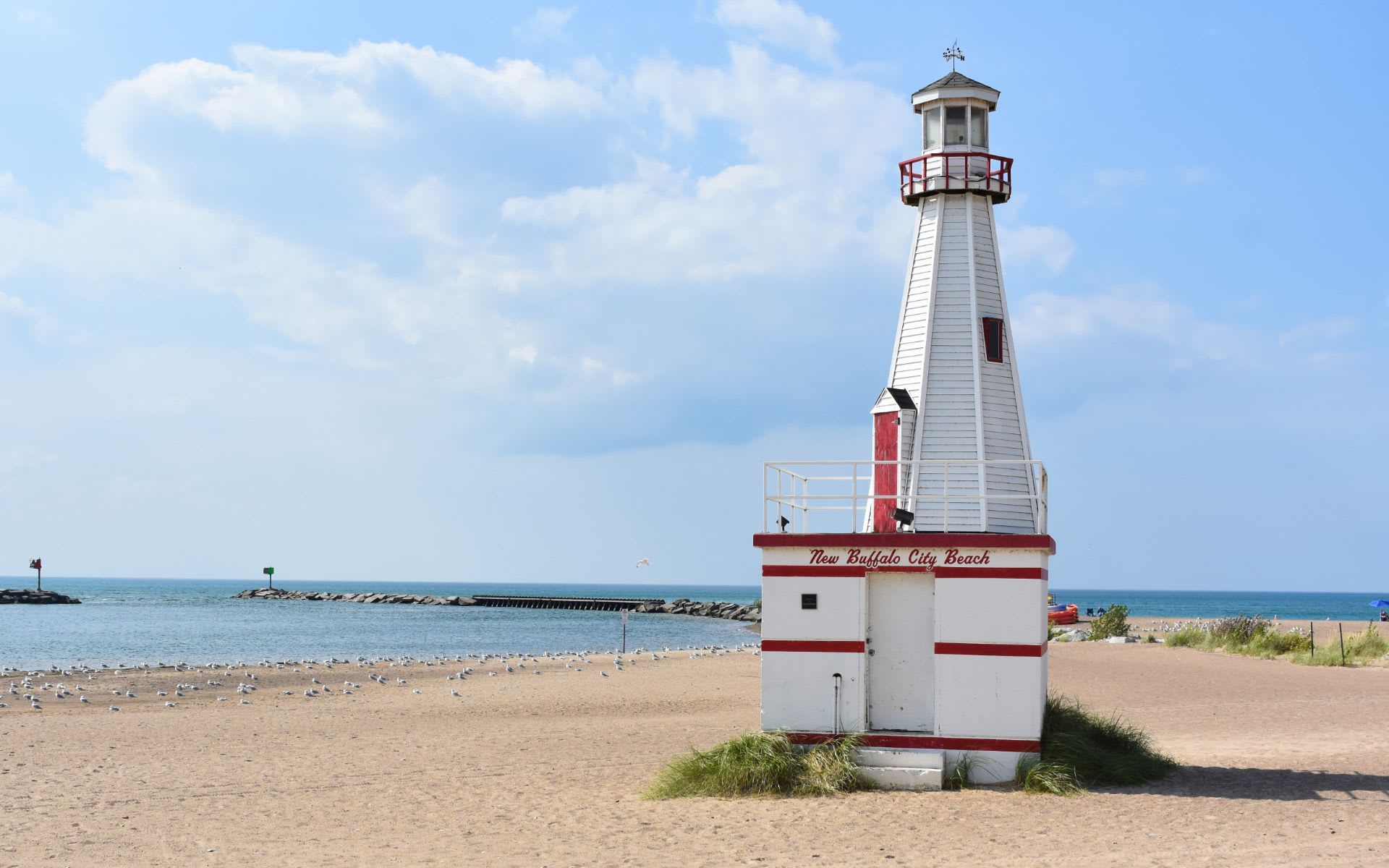
Living in New Buffalo, Michigan: Schools, Taxes, Beaches, History, Rules, and Home Prices
Meta description: Thinking about living in New Buffalo, Michigan? Here is a full buyer guide from Team Popp covering schools, property taxes, beaches, beach access, rules, history, and home price ranges.
New Buffalo, Michigan is one of the most strategic Lake Michigan markets in the region. It gets attention because of the beach-town atmosphere, but the real value proposition is bigger than that. New Buffalo gives buyers public beach access, a real harbor, a walkable downtown core, direct rail access, and close proximity to Chicago, while still feeling like a proper lake town instead of a generic suburb with water nearby. Michigan’s official tourism site describes New Buffalo as a historic Lake Michigan beach town about 70 miles from downtown Chicago, with sixteen miles of uninterrupted shoreline in the broader area.
For Team Popp, New Buffalo matters because it fits multiple buyer profiles at once. It works for primary-residence buyers who want year-round livability. It works for second-home buyers who want a cleaner, more established Lake Michigan lifestyle. It works for some luxury buyers who want marina access, lake adjacency, and downtown convenience in one package. And it works for investors and vacation-home shoppers who understand that New Buffalo is not just a pretty destination. It is one of the core gateway markets for Harbor Country. The City of New Buffalo itself brands the community as “The Gateway of Michigan,” and its public-facing city site puts beach, harbor, zoning, parking, and property-record resources front and center.
The smart way to evaluate New Buffalo is not to ask, “Is it nice?” It is nice. The real question is whether its combination of schools, taxes, beaches, rules, and price points fits your goals better than nearby alternatives like Union Pier, Lakeside, Long Beach, or Michiana Shores. That is what this page is built to answer.
Where is New Buffalo, Michigan?
New Buffalo is in southwest Michigan, in Berrien County, on Lake Michigan near the Indiana border. The city sits at the mouth of the Galien River and combines a public beach, riverfront, harbor, marina, and downtown district in one relatively compact geography. The city’s official beach page places the public beach and Lakefront Park on the north end of Whittaker Street, just across the Galien River Bridge. The city’s harbor page says New Buffalo Harbor has more than 950 boat slips, including seasonal and transient slips.
That location is a major part of the draw. Buyers are not just choosing a house. They are choosing a logistics advantage. You can be in a real Lake Michigan town with beach access, boating infrastructure, and downtown amenities without feeling isolated. That is why New Buffalo continues to attract buyers from Chicago, Northwest Indiana, and beyond. Michigan’s tourism office specifically highlights its shoreline, harbor, and regional appeal, and the city’s own visitor page pushes beach and wave conditions, harbor livestreams, and local attractions because those are central to how the town is used.
What is it like living in New Buffalo, Michigan?
Living in New Buffalo is a hybrid lifestyle. It is part beach town, part boating town, part commuter-access town, and part year-round residential community. That mix matters. Some Lake Michigan towns are primarily seasonal. New Buffalo has a more complete operating ecosystem because it combines public waterfront infrastructure, schools, municipal services, and an established downtown with regular residential life. The city’s parks and harbor department manages not only the beach and marina but also multiple parks and civic facilities.
For buyers, the feel on the ground is one of the biggest selling points. You have public waterfront energy without losing the sense that people actually live here. The city beach, boat launch, riverfront, Lions Pavilion Park, and harbor are all functionally connected within the same waterfront area, which makes the city feel active and usable rather than fragmented. The city notes that these properties were part of a 1924 gift to the village, later city, by the Warren Featherbone Company, and that the city later received a quitclaim deed extinguishing any reversionary interest. That civic ownership history matters because it helps explain why the public waterfront is such a defining part of New Buffalo’s identity.
The blunt truth is that New Buffalo is popular because it gives buyers more optionality than many nearby towns. You can do beach days, boating, dining, rail trips, and a normal grocery-and-school routine from one address. That is a serious competitive advantage for resale and long-term demand.
Beaches in New Buffalo, Michigan
The public beach is the headline amenity. The City of New Buffalo says its beach and Lakefront Park include nearly 800 feet of sandy beach at the north end of Whittaker Street. The city tourism ecosystem and regional visitor sites consistently position New Buffalo Public Beach as the main waterfront draw, with easy access from downtown and the harbor area.
What makes New Buffalo different from some private-association beach markets is that the city beach is a public asset. That is good for buyers who want reliable public access and not just deeded or association-based rights. It also means the beach experience is shaped by city rules, parking systems, public monitoring, and seasonal staffing. Berrien County’s public bathing beach page says county health staff monitor public beaches and direct users to the state’s Beach Guard system for current sampling results. That is an important buyer detail because public-beach access is great, but smart buyers also want to know how water quality and beach safety are managed.
The beach itself is not an isolated strip of sand. It is part of a broader waterfront system that includes the city boat launch, riverfront, Lions Pavilion Park, and harbor. That gives New Buffalo a more layered waterfront lifestyle than towns where the beach is the only waterfront asset. If you want to live near water but also care about boating, paddling, river access, and activity beyond sitting on the sand, New Buffalo is stronger than many buyers initially realize. The city’s water trails page specifically notes paddling access to three water trails, including Lake Michigan and the Galien River.
Beach stops and access points in New Buffalo
If you are writing for buyers, the phrase “beach stops” needs to be practical. In New Buffalo, the main public beach stop is the City Beach and Lakefront Park area at the north end of Whittaker Street. That is the primary public sand-and-water access point buyers need to understand. The beach parking lot, city boat launch, riverfront, and Lions Park/Pavilion area all work as part of the same waterfront zone.
So for actual buyers evaluating New Buffalo, the key waterfront stops are:
City Beach / Lakefront Park — the main public beach access point with sandy shoreline.
Beach Parking Lot — the main paid parking area serving the waterfront. The city says pay-to-park is enforced from 8:00 a.m. to 8:00 p.m. and lists both daily and three-hour rates.
Lions Pavilion Park — across from the City Beach, used as part of the broader lakefront park system.
City Boat Launch and Riverfront — part of the same waterfront parcel, which matters to buyers who want to boat, paddle, or combine beach use with other water access.
Harbor / Marina area — a major New Buffalo differentiator, especially for buyers who care about boat access or harbor-adjacent lifestyle value.
That is the cleanest way to explain “beach stops” for New Buffalo: not as a chain of numbered access stairs like in some shoreline communities, but as a concentrated public waterfront district anchored by the City Beach.
Beach rules buyers should know
This is where generic blogs usually fail. Buyers need rules, not fluff.
The City of New Buffalo’s official beach page says animals are not allowed on the city beach or city parks under City Ordinance 180. It also says parking fees begin April 1 and end October 31, and that sunsets and sunrises remain free. The separate beach parking page says pay-to-park is enforced from 8:00 a.m. to 8:00 p.m. and currently lists $20 daily parking and $10.50 for three-hour parking.
That is operationally important. If a buyer is thinking, “We will just take the dog to the beach every day,” that assumption is wrong for the city beach. If a buyer is thinking, “Parking will be easy and free all season,” that is also wrong. Those are not minor details. They affect how owners actually use the town.
Regional visitor information for New Buffalo Beach also says lifeguards are on duty from Memorial Day through Labor Day, with shoulder-season and peak-season schedules, and that beach warning flags must be obeyed. It specifically notes that under Michigan law, double red flags mean you are not allowed to enter the water from the beach. Berrien County separately warns that Lake Michigan conditions can become hazardous quickly and that swimmers should understand water and wave conditions before entering.
The practical Team Popp takeaway is simple: New Buffalo has a real public beach, but it is a managed environment. Owners and guests need to respect animal restrictions, parking rules, flag warnings, and seasonal operating patterns. Buyers who value a more structured, safety-conscious public beach usually see that as a plus.
Schools in New Buffalo, Michigan
New Buffalo Area Schools are one of the strongest lifestyle assets in the city. The district says it serves about 560 students in grades PreK-12, maintains small class sizes, and has earned major recognition. The district states that New Buffalo High School was named a National Blue Ribbon School in 2019, the elementary school was named a National Blue Ribbon School in 2020, and the district was named Most Innovative District of the Year in Michigan by MACUL in 2024.
That is a serious selling point. In smaller lake communities, buyers often assume schools are either limited or secondary to the lifestyle story. In New Buffalo, the schools are a genuine part of the value story. The district’s board page also confirms that the school system is elected by citizens of the City of New Buffalo, New Buffalo Township, and Chikaming Township, which shows the district has a broader regional service footprint.
For families, the attraction is straightforward: New Buffalo offers a rare combination of small-town scale and a district with real brand equity. Small class sizes matter. Blue Ribbon recognition matters. A district this size can feel more personal than larger systems, which is part of why New Buffalo continues to attract buyers who want a beach-town lifestyle but do not want to sacrifice school quality.
The honest version is that not every buyer comes to New Buffalo because of schools. But the schools absolutely strengthen the town’s resale profile and widen the buyer pool. A town that works for second-home buyers, retirees, and families is a stronger town than one that only works for one category. New Buffalo Area Schools help New Buffalo do that.
Property taxes in New Buffalo, Michigan
Michigan property taxes require a smarter explanation than most blogs give. The first thing buyers need to know is that principal-residence status matters a lot. Michigan Treasury says a Principal Residence Exemption (PRE) exempts an owner’s principal residence from the local school operating millage, up to 18 mills.
That means a buyer using a New Buffalo property as a full-time primary residence can have a meaningfully different tax profile than a second-home buyer. In a market like New Buffalo, where many properties are used seasonally or as non-homestead holdings, that distinction is not theoretical. It affects real carrying costs.
The second major point is uncapping. Michigan Treasury says a change of ownership may affect taxes because a transfer of ownership can trigger taxable-value uncapping under the General Property Tax Act. In plain English, a buyer cannot safely assume the seller’s current tax bill will be the buyer’s future tax bill. That mistake costs people money every year.
This is where New Buffalo buyers need discipline. Michigan’s system is not just about current assessed value. It is about whether the property is homesteaded, whether a transfer triggers uncapping, and how taxable value resets over time. A second-home buyer coming from Illinois or Indiana often needs that explained clearly because the holding-cost math can shift after purchase.
The practical Team Popp rule is this: do not ask, “What are taxes in New Buffalo?” Ask, “What are my likely taxes on this property after closing, under my intended use?” That is the right underwriting question.
History of New Buffalo, Michigan
New Buffalo’s history is not generic beach-town mythology. It has a specific origin story, and that story still shapes how the market feels today. According to New Buffalo Township’s history page, the city came into being after a violent October storm in 1834, when Captain Wessel D. Whittaker grounded his schooner, the Post Boy, near State Creek. The ship was destroyed, but the event led to the recognition of the site’s harbor potential and eventually to settlement and development. A Berrien County community profile echoes the same origin story.
That matters because New Buffalo did not begin as a generic resort invention. It began as a place with real transportation and harbor logic. Over time, rail and lake access shaped its growth, which is why the community still has a transportation and waterfront identity that feels more grounded than purely seasonal resort towns. The Harbor Country Museum of History + Rail, formerly the New Buffalo Railroad Museum, specifically ties the region’s development to railroad history in the greater New Buffalo area.
The city’s own beach page adds another important layer by noting that the waterfront parcel that includes the beach, boat launch, riverfront, and Lions Park was given to the village in 1924 by the Warren Featherbone Company. That gift locked in a civic waterfront legacy that still drives the town’s public identity today.
So when buyers say New Buffalo feels like a “real town,” not just a constructed destination, that instinct is correct. The combination of shipwreck-and-harbor origins, rail history, and longstanding public waterfront ownership gives New Buffalo more historical coherence than many comparable markets.
Home price ranges in New Buffalo, Michigan
New Buffalo pricing is broad, which is exactly why buyers need clean framing.
Realtor.com currently says homes for sale in New Buffalo have a median listing price of $607,500, with 88 active homes for sale and an average of 41 days on market. It also shows the 49117 ZIP code at $785,000, which helps explain why the market often feels more expensive than casual buyers expect.
That headline number is useful, but it does not tell the full story. The active market spans smaller cottages and inland properties under $500,000, a large middle band in roughly the $500,000 to $900,000 range, and a premium and luxury segment above $1 million. Realtor.com’s New Buffalo page explicitly shows homes for sale across multiple price buckets under $100k, $200k, $300k, $400k, and $500k, while current visible listings include properties at $435,000 and nearby examples around $499,900, $539,900, $559,000, $600,000, $659,000, and $695,900.
The upper end climbs fast. Zillow shows a current New Buffalo listing at $1,950,000 on Lilac Lane, and the same page references another nearby new-construction listing at $2,800,000 and other New Buffalo offerings above $1 million.
So the clean Team Popp pricing framework for buyers looks like this:
Entry/lower band: roughly under $500,000, typically smaller homes, more modest condition, or less prime positioning.
Core market band: roughly $500,000 to $900,000, where many serious buyers compete for well-located cottages, updated homes, and more usable year-round product.
Upper-premium band: roughly $900,000 to $1.5M, where you begin to see stronger design, better location, larger lots, and more refined second-home inventory.
Luxury band: $1.5M+, including new construction, harbor-adjacent, larger homes, and top-tier positioning.
The key is not to read those bands too literally. In New Buffalo, value moves quickly based on walkability, beach proximity, harbor access, lot size, design quality, rental history, and whether the home feels like a throwback cottage or a polished luxury product. Two houses with similar square footage can trade in very different value lanes if one is near the beach and the other is not.
Who should consider living in New Buffalo?
New Buffalo is strongest for four buyer types.
First, it works for the primary-residence buyer who wants a small-town Lake Michigan lifestyle with real infrastructure. Schools, city services, and public amenities make that possible.
Second, it works for the second-home buyer who wants easier public beach access and more activity than some quieter Harbor Country enclaves. The beach, harbor, downtown, and rail appeal all help here.
Third, it works for the boating buyer. Not every Lake Michigan town gives you this much harbor infrastructure, and New Buffalo’s harbor is a serious differentiator.
Fourth, it works for the resale-conscious buyer who understands that towns with schools, waterfront infrastructure, and broad buyer appeal tend to stay liquid relative to more niche markets.
Final take: is New Buffalo, Michigan a good place to live?
Yes. For the right buyer, New Buffalo is one of the most complete Lake Michigan communities in southwest Michigan. It offers a real public beach, harbor and marina infrastructure, respected schools, a clear historic identity, and a price ladder that ranges from attainable cottages to legitimate luxury. Its tax picture requires smart analysis because Michigan’s PRE and uncapping rules matter, and its beach use is governed by real parking, animal, and safety rules. But those are manageable issues when you understand them up front.
The blunt truth is that New Buffalo works because it is not one-dimensional. It is not just a beach. It is not just a vacation town. It is not just a harbor. It is a layered market with enough infrastructure and identity to support both lifestyle and long-term demand. That is why serious buyers keep circling back to it.
Why buyers work with Team Popp in New Buffalo, Michigan
Buying in New Buffalo is not just about finding a nice house near Lake Michigan. Buyers need to understand beach access, parking rules, school quality, tax implications, ownership costs, and where pricing changes block by block. Sellers need to know how to position New Buffalo correctly against Harbor Country and Northwest Indiana alternatives.
That is where Team Popp brings value.
Team Popp helps buyers and sellers evaluate:
- beach and harbor lifestyle fit
- schools and family-use practicality
- Michigan tax realities, including principal-residence strategy
- property positioning inside New Buffalo’s price bands
- second-home, luxury, and long-term resale potential
Thinking About Buying in New Buffalo, Michigan?
If you are researching New Buffalo for a primary home, second home, or Lake Michigan investment, Team Popp can help you go beyond the listings and understand what actually drives value.
We help buyers evaluate:
- beaches and access
- schools and lifestyle fit
- property taxes and ownership costs
- home pricing and negotiation strategy
Team Popp helps buyers and sellers make smarter decisions across New Buffalo, Harbor Country, and Northwest Indiana by focusing on lifestyle fit, market positioning, and long-term value near Lake Michigan.
Start with a conversation at teampopp.com
Scott: 312-391-8841
Carlos: 219-249-6100